Spine, glutes, and hamstrings do most of the work. The spine is the main load, with the glutes and hamstrings assisting.
Why the setup changes the target
With your hips supported on the ball and your feet braced, the rep shifts onto the back side of the body instead of letting you cheat it through the lower back. That setup is what lets the spine, glutes, and hamstrings share the work as you lift into one straight line from head to heels.
If your hips drift off the ball, you lose that support and the rep stops feeling like a clean back-side extension. Keep the lowering slow so the same muscles stay under tension on the way down.
What a clean rep should feel like
A clean rep should feel like your spinal extensors start the lift and your glutes and hamstrings finish it as your body comes into one straight line. The work should stay on the back side of your body, not turn into a loose swing off the ball.
At the top, it should feel tall and controlled, with the glutes and hamstrings holding the position while the spine stays extended. The pause is where the rep feels most organized.
On the way down, the same muscles should keep tension as you lower slowly back to the ball. If the descent rushes, you lose that controlled back-side load.
When the rep becomes mostly back work
Spine, glutes, and hamstrings do the work here, but it turns into mostly back work when you keep the hips parked on the ball and keep extending through the lumbar spine instead of driving from the hips. If the chest rises while the pelvis stays glued down, the load stays high on the back body and the glutes and hamstrings never get a strong say.
That shift usually shows up when the range gets bigger than your hip position can support, or when you chase the top position with a hard arch instead of a straight line from head to heels. A clean rep should still feel braced and controlled; a back-dominant rep feels like the lumbar spine is taking over the lift and the lowering phase is just as tense as the way up.
When the glutes and hamstrings take over
Keep the rep tight and stop at a straight line. Once you reach that position, the work stays in the glutes and hamstrings; if you keep pushing higher, it turns into more of a back extension. Lower under control and keep the feet fixed so the body stays steady on the ball.
How to read your video
Watch for a stable hip position on the ball, a straight line at the top, and a slow lower. Keep each rep controlled; if the torso snaps up or drops fast, the movement is losing control.
Common questions about muscles worked
Spine, glutes, and hamstrings do the main work here. The feel shifts with how cleanly you keep the hinge and how much the move stays aligned from head to heels.
Back Extension On Exercise Ball: the movement, step by step
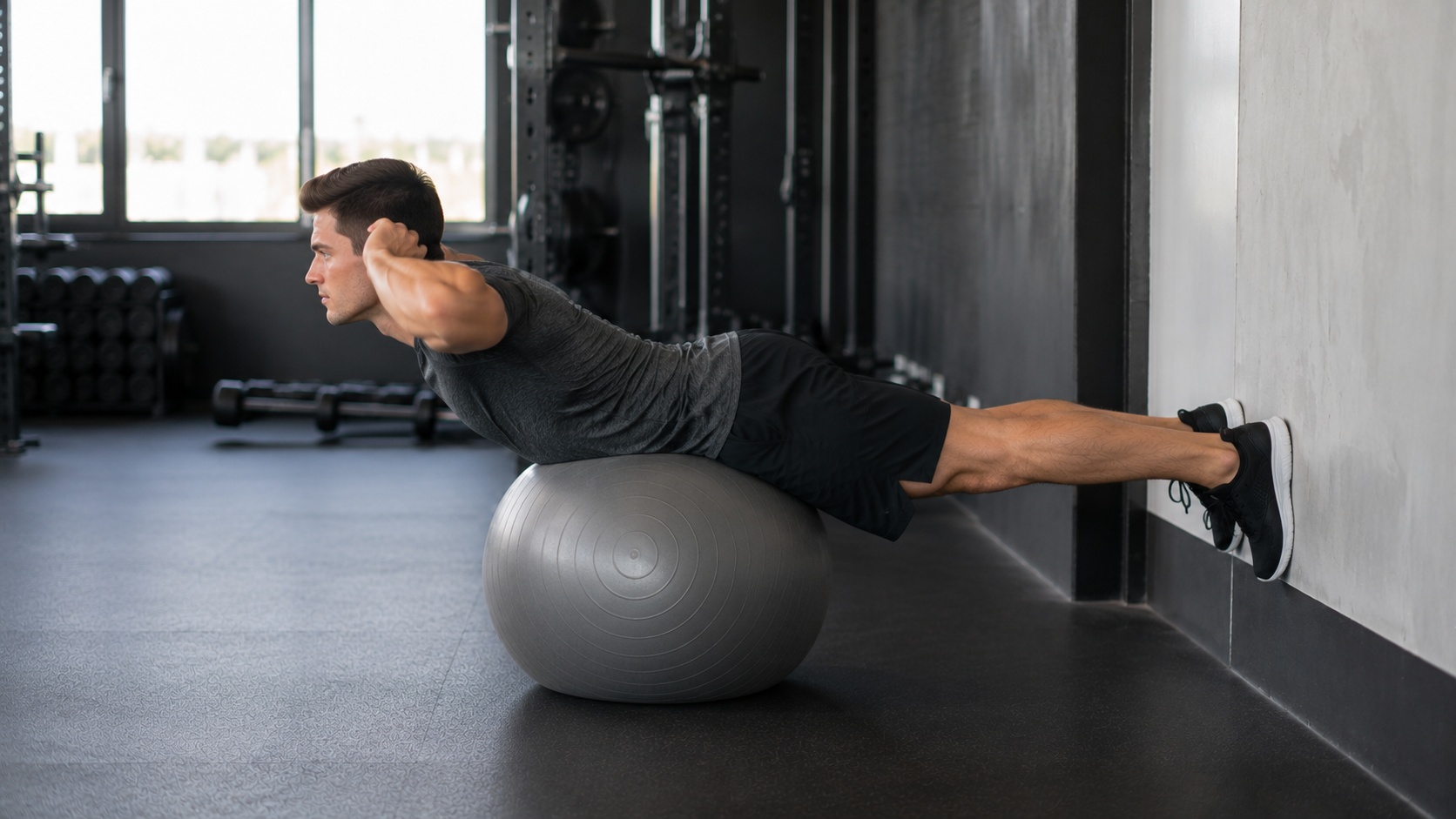
- Place the stability ball on the ground and lie face down on top of it, with your hips resting on the ball and your feet against a wall or other stable surface.
- Position your hands behind your head or crossed over your chest.
- Engage your core and slowly lift your upper body off the ball, extending your back until your body forms a straight line from your head to your heels.
- Pause for a moment at the top, then slowly lower your upper body back down to the starting position.
- Repeat for the desired number of repetitions.
Common questions
What muscles do back extensions on an exercise ball work?
Spine, glutes, and hamstrings do most of the work. The spine is the main load, with the glutes and hamstrings assisting.
Why does the setup change the target?
With your hips supported on the ball and your feet braced, the rep shifts onto the back side of the body instead of letting you cheat it through the lower back.
When does the rep become mostly back work?
It becomes mostly back work when you keep the hips parked on the ball and keep extending through the lumbar spine instead of driving from the hips.
What should a clean rep feel like?
A clean rep should feel like the spinal extensors start the lift and the glutes and hamstrings finish it into one straight line. The descent should stay slow and controlled.
The hardest part of fixing any of this is that you cannot see yourself mid-rep. Corect reads your form from a phone video and shows you what actually happened on each rep of your back extension on exercise ball — depth, bar path, where the breakdown starts. Try it free.