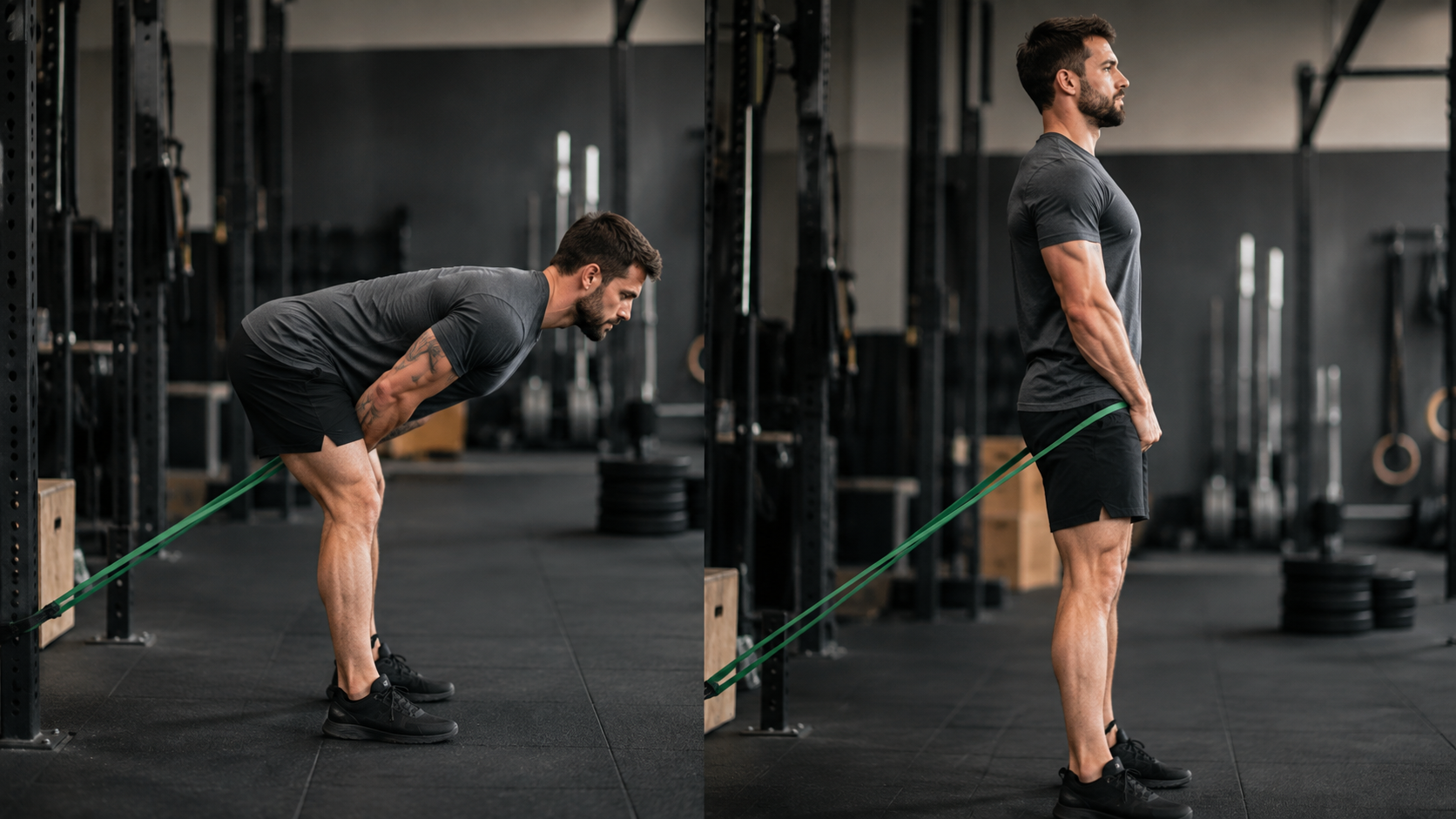

This is a band pull through: the band stays taut from a low anchor so your glutes and hamstrings do the work while your lower back supports the finish.
It teaches you to send the hips back with a slight knee bend, then drive them forward to stand up. The rep should feel like your hamstrings lengthen as your torso lowers and your glutes squeeze to bring you back, at home or in the gym.
How to set it up
Set the band low and step far enough away that it is already pulling on you before the first rep. Use a shoulder-width stance with a slight bend in the knees, and keep moving forward until the band stays loaded from the start.
If the band is slack, the setup is wrong. You want steady tension as soon as you finish stepping out, with your feet set and your knees soft so the first rep begins under load.
How each rep should move
Each rep should feel like the hips move, not like you drop straight down. Keep the knees soft and let the torso tip as the hips go back, so the stretch lands in the hamstrings and upper legs instead of collapsing into the knees.
On the way up, drive the hips forward and finish by squeezing the glutes. Stay tall at the top without turning it into a low-back arch.
What you should feel
You should feel the band stay taut as your hips move back and your torso folds forward with a slight bend in the knees. At the bottom, the stretch runs through the back of the upper legs.
The finish comes from driving the hips forward and squeezing the glutes. At the top, the glutes are tight and the band stays under control.
Common form errors
The most common breakdown is losing band tension. If you step too close to the anchor or let your hips drift forward too soon, the rep goes soft and you stop loading the hinge; it should feel like the band is always trying to pull you back.
The next mistake is turning the hinge into a squat. Your knees should stay softly bent, not keep bending as you descend. When that happens, the torso stays too upright, the hips never travel back far enough, and you miss the hamstring stretch that should show up as your upper body tips forward.
The finish can go wrong too. If the rep ends with a hard arch through the lower back, the pelvis is no longer coming through under the torso; the glutes stop driving the movement and the low back takes over. A clean rep finishes with the hips forward, the glutes tight, and the torso stacked without a lean-back.
How to fix bad reps from video
Film from the side and keep the band in view. Because this move starts with you stepping away from a ground-level anchor, the first check is whether the band stays under tension instead of going slack before the hips hinge.
On the way down, your hips should move back against that tension while your knees keep a slight bend. If the torso stays too upright, the knees creep forward, or the low back rounds to find depth, the hinge is not doing the work.
On the way up, the hips should drive forward and finish with the glutes. If you see a hard lean-back, ribs flaring, or the low back taking over at the top, you are missing the clean hip drive.
Ask one question from the video: did the band stay loaded while the hips moved back and through, or did the spine do the rep?
Home and gym setup notes
The only setup that matters is the anchor: keep the band fixed at ground level and step out far enough to create tension before you start. If the anchor is higher, the pull changes and the rep stops feeling clean.
Stand facing away from the anchor with your feet about shoulder-width apart, then take the step that sets the band taut. Keep your knees slightly bent, hinge at the hips, and let your glutes travel back as your torso folds forward.
Band Pull Through: the movement, step by step
- Attach a resistance band to a sturdy anchor point at ground level.
- Stand facing away from the anchor point with your feet shoulder-width apart.
- Step forward to create tension in the band, keeping your knees slightly bent.
- Hinge at the hips and push your glutes back, maintaining a slight bend in your knees.
- Lower your torso until it is parallel to the ground, feeling a stretch in your hamstrings.
- Drive your hips forward and squeeze your glutes to return to the starting position.
- Repeat for the desired number of repetitions.
Common questions
How should you set up a band pull through?
Set the band low and step far enough away that it is already pulling on you before the first rep. Use a shoulder-width stance with a slight bend in the knees and keep steady tension from the start.
What should each rep of a band pull through feel like?
The movement should feel like the hips travel back while the torso tips forward, with the hamstrings lengthening as you lower. On the way up, drive the hips forward and finish by squeezing the glutes.
What are the most common band pull through mistakes?
The biggest mistakes are losing band tension, turning the hinge into a squat, and finishing with a hard arch through the lower back. A clean rep keeps the band loaded, the knees softly bent, and the torso stacked at the top.
How can you check your band pull through form from video?
Film from the side and keep the band in view. Check that the band stays loaded, the hips move back and through, and the spine does not do the rep.
Corect analyses your lifting form from a phone video and shows you what changed rep to rep. See how it works.