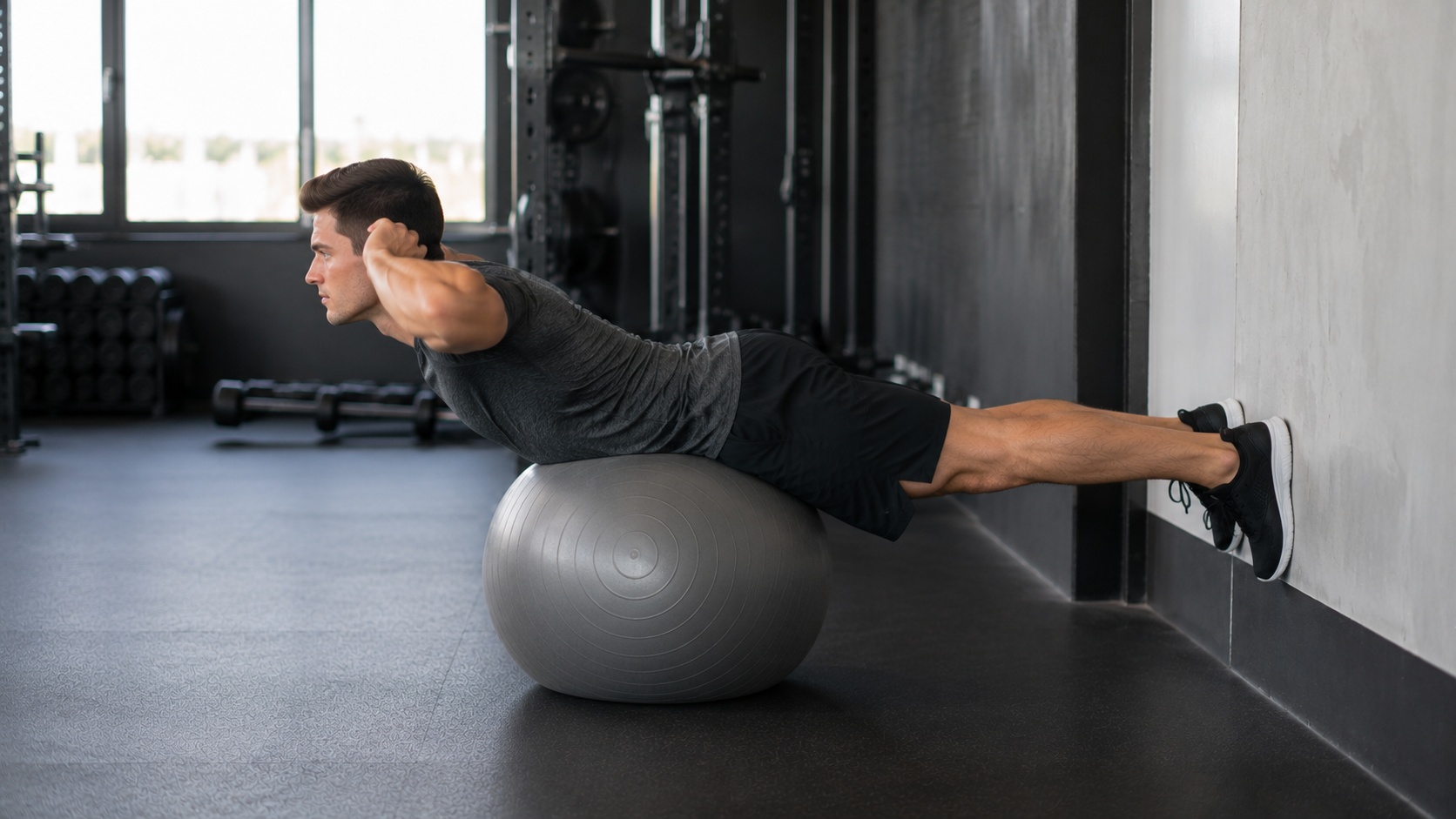
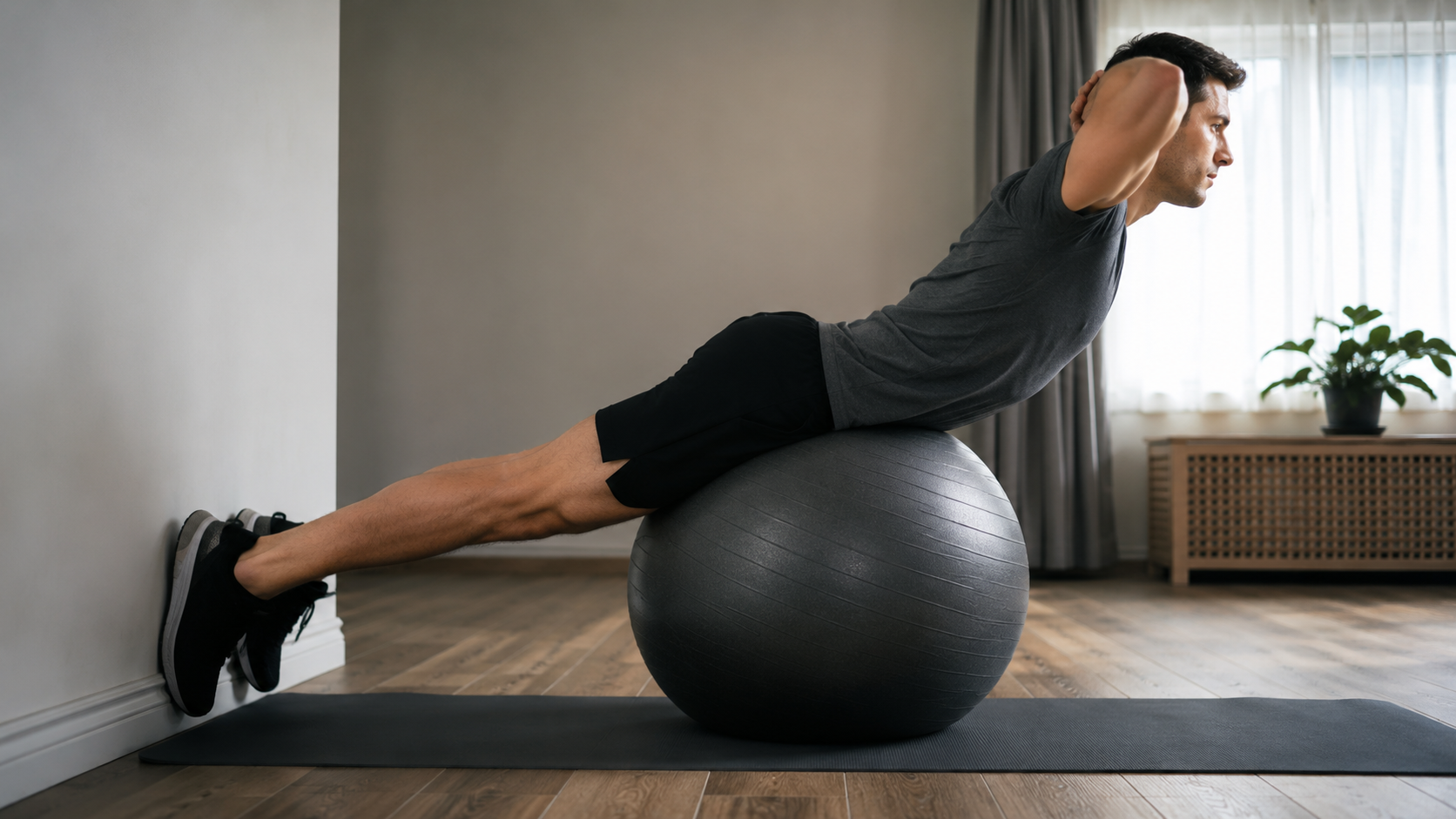
Use this when you want a back-focused floor variation that also loads the glutes and hamstrings. Set your hips on the stability ball with your feet braced, lift your torso until you make a straight line from head to heels, pause, then lower under control.
Setup on the ball
Your hips should already be settled on the ball, with your feet fixed against a wall or other stable surface before you start. Hands stay behind your head or crossed over your chest. From there, the setup is only right if you can brace cleanly and move without the ball shifting or your torso starting out of position.
How the rep should move
The useful part here is the shape at the top, not the step-by-step path to get there. You want a straight, stacked line from head to heels with the core doing the work of holding it there.
The pause should look still, not bouncy. On the way down, keep the lowering controlled and keep the hips settled on the ball.
What you should feel
You should feel the work in your spine, glutes, and hamstrings, with your hips staying planted on the ball and your feet holding you steady. At the top, the effort should run from your mid-back into a straight line through your body, not turn into a hard arch or a loose swing off the ball.
A good rep feels strongest through the glutes and hamstrings as you lift, then solid and brief at the top before you lower. On the way down, keep the same tension so the ball stays still and your torso does not drop back to the start.
Common form errors
The main errors are a loose brace, overextending at the top, cutting the range short, or dropping too fast on the way down.
A better rep stays tight through the middle, reaches a clean straight line at the top without throwing the chest up, and lowers under control with a brief pause before each descent.
How to check yourself on video
Film from the side and check for one clean rise and return. At the top, the body should lengthen into a straight line from head to heels, with the pause clear and the descent slow.
If the hips slip off the ball, the feet move, or the rep drops back down instead of lowering under control, the video is telling you the same thing: the line and tempo have gone.
At-home setup notes
This setup works at home or in a gym. You need a flat floor and a stable wall or other solid surface for your feet so the ball stays planted while you move. If your feet slide, the rep loses its shape before you even get to the top.
Keep your hips on the ball and use the support only to anchor yourself. The clean rep is the one where your upper body moves without the ball shifting under you.
When the ball version is not a fit
If the ball setup makes the rep hard to control, use a more stable back extension option for that session. The goal is the same pattern with a setup you can repeat cleanly, not fighting the ball.
Back Extension On Exercise Ball: the movement, step by step
- Place the stability ball on the ground and lie face down on top of it, with your hips resting on the ball and your feet against a wall or other stable surface.
- Position your hands behind your head or crossed over your chest.
- Engage your core and slowly lift your upper body off the ball, extending your back until your body forms a straight line from your head to your heels.
- Pause for a moment at the top, then slowly lower your upper body back down to the starting position.
- Repeat for the desired number of repetitions.
Common questions
How should the rep look on an exercise ball back extension?
You want a straight, stacked line from head to heels at the top. The pause should look still, and the lowering phase should stay controlled.
What should you feel during the movement?
You should feel the work in your spine, glutes, and hamstrings, with your hips staying planted on the ball and your feet holding you steady.
What are the most common form errors?
The main errors are a loose brace, overextending at the top, cutting the range short, or dropping too fast on the way down.
When is the ball version not a fit?
If the ball setup makes the rep hard to control, use a more stable back extension option for that session. The goal is the same pattern with a setup you can repeat cleanly.
The hardest part of fixing any of this is that you cannot see yourself mid-rep. Corect reads your form from a phone video and shows you what actually happened on each rep of your back extension on exercise ball — depth, bar path, where the breakdown starts. Try it free.