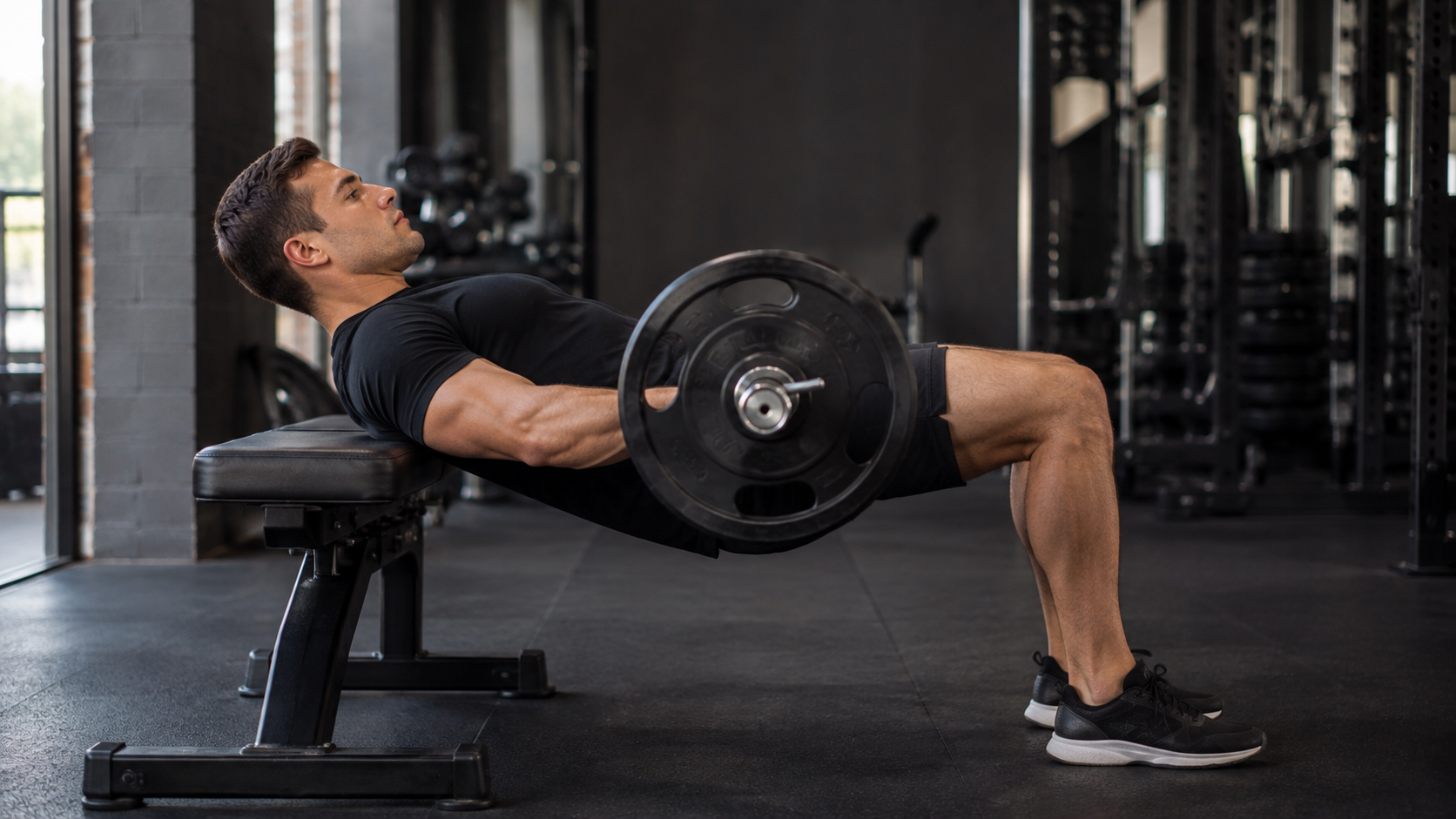
Set up flat on your back with your knees bent, feet flat, and a barbell across your hips. From there, the lift is about driving your hips up until you reach a straight line from knees to shoulders, pausing at the top, then lowering under control.
It should load the glutes and hamstrings through the upper legs, with the lower back only assisting if you keep the position clean. Corect can score that rep from video.
Setup on the floor
Lie back with your upper back planted and the bar secured across your hips. Start from a stable position so the first rep moves cleanly, without shifting or losing control.
How the rep should move
The rep should rise with the glutes and core braced, not by arching the lower back. At the top, keep the ribs down and the body in a straight line from knees to shoulders.
Pause there with the barbell steady across the hips and the glutes squeezed. Lower under control back to the start, keeping the same tension instead of dropping out of position.
What you should feel
A correct rep should finish with the glutes doing the work, not the lower back taking over. At the top, the hips should come through until the body is in a straight line from the knees to the shoulders, with a brief squeeze in the glutes rather than a bend through the spine.
The descent should stay controlled as the hips return to the start position. If the hips finish by overextending, the lower back is usually doing too much of the work.
Common mistakes and what they look like
If the lift feels mostly in your hamstrings or lower back, the issue is usually showing up before the top: the setup is off, the ribs are loose, or you are finishing by bending your spine instead of driving the hips through. In a clean rep, the glutes do the work and the top position looks stacked, not bent backward.
Feet too far away usually show up as the hips having to reach before they can rise. Too close, and the knees crowd in so much that the push turns short and cramped. On video, look for a setup that lets the shins stay usable and the hips travel straight up instead of scooping forward.
At lockout, do not keep lifting once your hips are already in line with your shoulders and knees. That extra reach is lower-back compensation, not more glute work.
If the ribcage pops up or the pelvis tips hard, you lose core position and the bar starts to ride the rep. The descent should stay controlled so each rep starts from the same place instead of resetting loose.
How to compare it with other moves
Compared with a bridge, this keeps the barbell across your hips, so the top position should feel like driving your hips up under load, not just lifting off the floor. You should still feel your glutes do the work; if it turns into lower back work, the top will keep rising instead of settling into a straight line from knees to shoulders.
Compared with a hamstring-dominant hinge, the bent knees and planted feet shift the effort toward your glutes and hamstrings together, rather than pulling from the back of the thighs alone. If your feet drift out of place, the rep can feel cramped or slide back into your hamstrings; the clean rep lowers under control, then finishes with a short squeeze at the top.
How to check your form on video
Film from the side and watch for changes rep to rep. Corect would flag it if one rep finishes short, the next one overarches, or the hips stop moving the same way each time.
The barbell should stay steady across the hips, and the top position should look clean, not higher through the lower back. If the feet drift, the bar shifts, or the hips rise unevenly, the set is losing position.
Hip Thrust: the movement, step by step
- Start by lying flat on your back on the ground with your knees bent and feet flat on the floor.
- Place a barbell across your hips, holding it securely with both hands.
- Engage your glutes and core muscles, then lift your hips off the ground until your body forms a straight line from your knees to your shoulders.
- Pause for a moment at the top, squeezing your glutes.
- Slowly lower your hips back down to the starting position.
- Repeat for the desired number of repetitions.
Common questions
How should a hip thrust rep move?
Set up with your upper back planted, knees bent, feet flat, and a barbell across your hips. Drive the hips up until your body is in a straight line from knees to shoulders, pause, then lower under control.
What should a correct hip thrust feel like?
A correct rep should finish with the glutes doing the work, not the lower back taking over. At the top, keep the ribs down and hold a brief squeeze rather than bending through the spine.
What are common hip thrust mistakes?
Common mistakes include feet that are too far away or too close, arching the lower back at lockout, letting the ribcage pop up, and losing control on the descent.
How can I check my hip thrust form on video?
Film from the side and look for clean, repeatable reps. The bar should stay steady, the hips should rise evenly, and the top position should look stacked rather than overarched.
The hardest part of fixing any of this is that you cannot see yourself mid-rep. Corect reads your form from a phone video and shows you what actually happened on each rep of your hip thrust — depth, bar path, where the breakdown starts. Try it free.