You should feel your lats and rhomboids take over as the band comes toward your chest, with your shoulders staying down and your shoulder blades moving back together. The band should stay tight from the start of the pull through the pause, then stay controlled as you return.
A clean rep feels anchored: legs still, core braced, torso only slightly leaned back, and elbows pulling until the squeeze finishes behind you. A messy rep is easy to spot on video: your chest drifts away from your feet, your shoulders climb toward your ears, your elbows stop before the band reaches your chest, or the band goes slack before the next pull.
Set up the band and body position
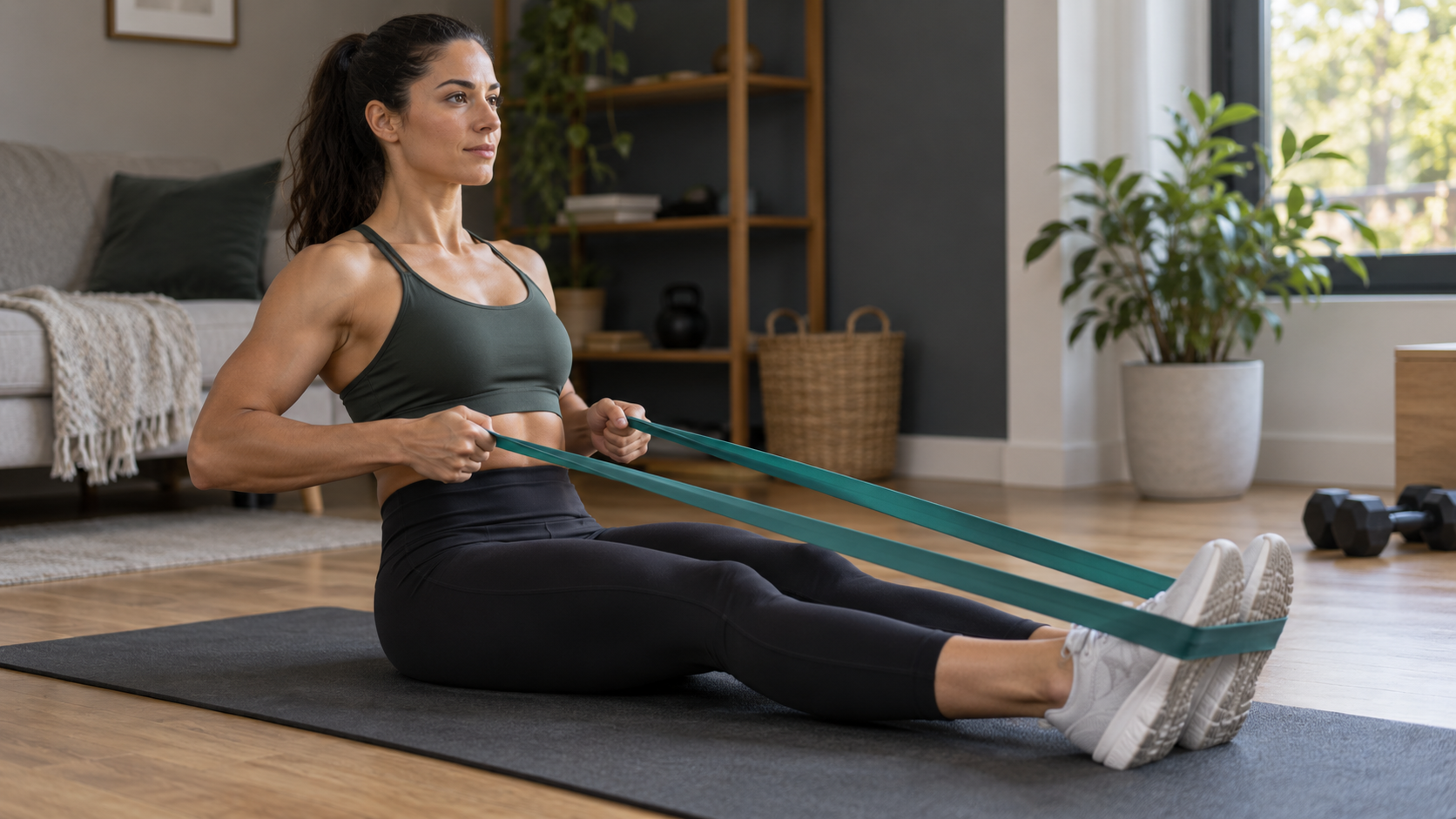
Sit with your legs extended and the band looped around both feet so the pull starts straight in front of you, not off to one side. If one foot is farther forward or the band sits unevenly, one elbow will usually travel farther than the other before the squeeze.
Hold the ends with your palms facing each other and start with light tension already in the band. If the band is slack at the start, the first part of the rep becomes a setup motion instead of a row.
Keep your back straight and lean back only enough to load the band. You should feel fixed through your torso while your elbows pull back; if your chest drifts away from your feet as the band gets harder, you are using body swing instead of finishing the pull.
Pull the band to your chest
Pull toward the lower chest or upper ribs, not up toward the neck. The band should travel in a straight line from your feet to your chest, with your elbows moving back close to your sides.
You should feel the shoulder blades slide toward each other before the hands finish the pull. If your shoulders climb toward your ears, the row has shifted into a shrug instead of a back pull.
Keep the slight lean you set at the start. If your chest moves backward as the band gets harder, you are adding torso swing to finish the rep.
At the top, the elbows should finish behind your body while the band still has tension. If the band goes slack before the squeeze, you have either pulled too short or released your shoulder blades too early.
Pause, lower, and keep tension
At the top, the band should still be pulling your hands forward while your shoulder blades stay squeezed together. Hold that position for a beat without shrugging your shoulders or leaning farther back to fake the finish.
On the way back, let your elbows travel forward slowly instead of letting the band snap your hands toward your feet. The rep is weak if the band goes slack before your arms return to the start, because the lats and rhomboids stop working before the row is actually finished.
From a phone video, look for three things: your torso should not drift backward during the pause, your shoulders should not climb toward your ears, and the band should stay stretched until the next pull begins.
Common form errors
Keep the torso quiet after the slight lean back. If your ribs drift backward every time you pull, you are turning the row into a body swing instead of making the lats and rhomboids finish the rep.
Watch your shoulders at the top. The squeeze should pull your shoulder blades together, not lift your shoulders toward your ears. From video, shrugging shows up as the neck disappearing while the handles reach the chest.
Do not stop the pull early. If the elbows quit behind your sides before the band reaches your chest, the rep loses the part where the upper back has to finish the squeeze.
Control the return until your arms are long again. If the band goes slack before you reach the start position, you released the rep instead of lowering it.
What Corect looks for in your video
Corect looks for checkpoints that are visible from the side or front: the band stays tight around your feet, your torso holds the same slight lean, and each pull brings your hands toward your chest instead of drifting down toward your lap.
It also checks the common breaks in this row: your shoulders creeping up as you pull, your elbows stopping before the squeeze, your upper body rocking back to create momentum, or the band going slack before you finish the pause. Those are the details that decide whether the rep is actually training your lats and rhomboids, or just moving the band back and forth.
Muscles worked
Your lats start the pull by drawing your upper arms back, while your rhomboids finish the rep by squeezing your shoulder blades together. Your biceps help bend the elbows, but if your hands move first and your shoulder blades never close, the row has turned into mostly an arm pull.
Your shoulders should stay down as the band comes toward your chest. If they climb toward your ears, your upper body is stealing the rep before your back finishes it.
Resistance Band Row: the movement, step by step
- Sit on the floor with your legs extended and loop the resistance band around your feet.
- Hold the ends of the resistance band with your hands, palms facing each other.
- Keep your back straight and lean slightly back, engaging your core.
- Pull the resistance band towards your chest, squeezing your shoulder blades together.
- Pause for a moment at the top, then slowly release the tension and return to the starting position.
- Repeat for the desired number of repetitions.
Common questions
How should you set up for a resistance band row?
Start with your legs extended, the band looped around your feet, and your hands on the ends with your palms facing each other. Keep your back straight and lean back only slightly.
Where should you pull the band?
Pull to the lower chest or upper ribs. Let the shoulder blades squeeze first, with the elbows driving back and in, while keeping the torso still.
What are the most common form errors?
The main mistakes are rocking the torso, shrugging, leaning back too far, cutting the pull short, and letting the band go slack on the way down. The rep should stay smooth and under tension.
What muscles does the resistance band row work?
Your lats and rhomboids do most of the work, with the biceps and shoulders helping. It should feel like a back-driven pull rather than an arm exercise.
The hardest part of fixing any of this is that you cannot see yourself mid-rep. Corect reads your form from a phone video and shows you what actually happened on each rep of your resistance band row — depth, bar path, where the breakdown starts. Try it free.