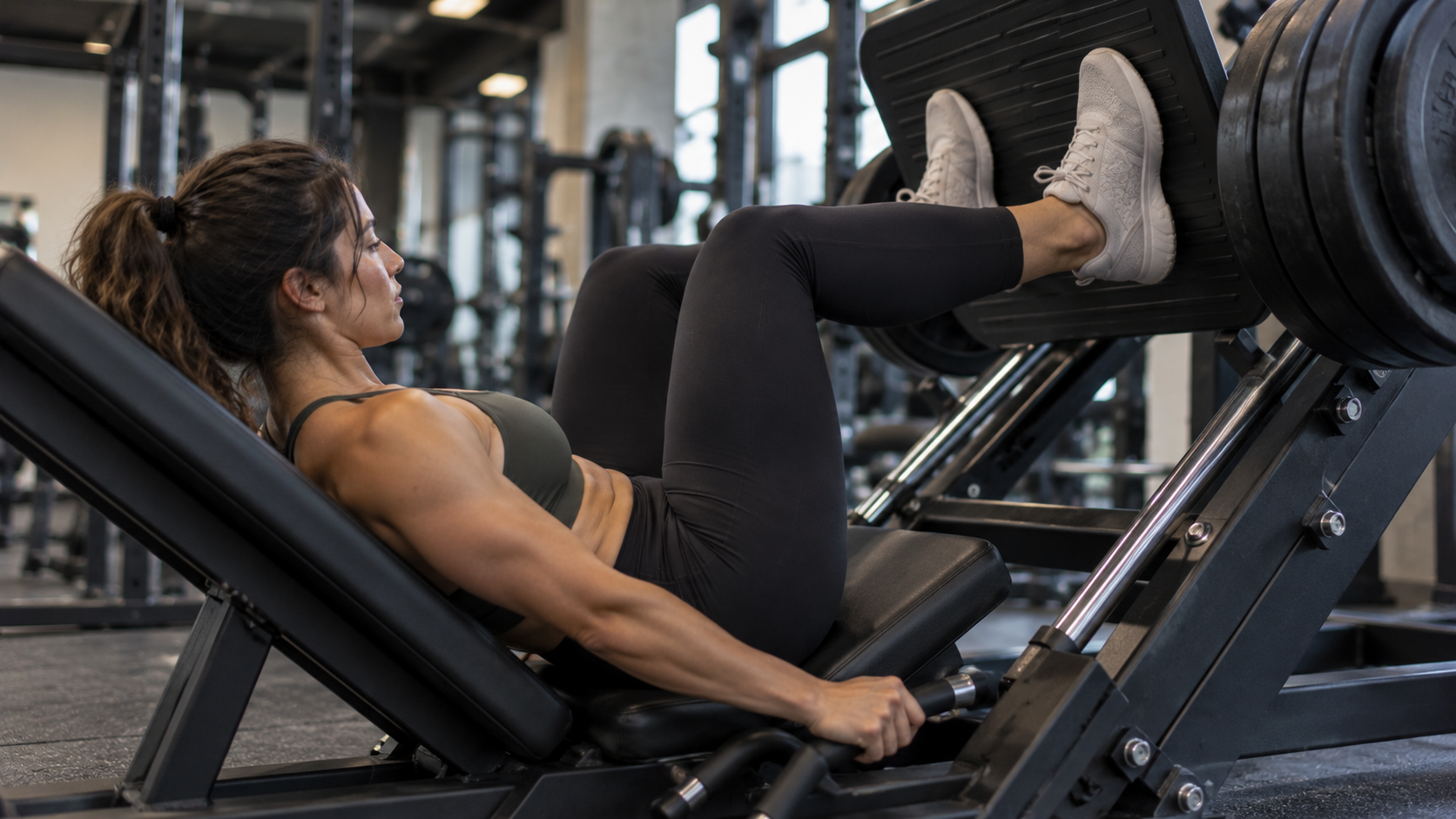
The leg press mainly trains your quadriceps and glutes. Your hamstrings and calves assist as secondary muscles while you press the footplate away, keep your heels down, and lower the sled under control. A shoulder-width foot position gives you the standard muscle balance for this machine: quads and glutes doing the main work, with hamstrings and calves supporting the rep.
Why foot placement changes the emphasis
This movement is mainly about the quadriceps and glutes, with the hamstrings and calves assisting. Foot position matters for setup and comfort, but the core muscle emphasis stays on the upper legs.
What the rep should look like
The rep should look smooth and controlled, with the knees tracking cleanly and the heels staying planted on the footplate. Lower under control, pause briefly, then press back up without locking out hard or bouncing off the bottom.
How depth changes the load
Depth changes how the rep is shared across your upper legs, but not in a clean on/off way. With a shorter rep, you spend more of the work near knee extension. With a deeper rep, the hips and knees travel through more range, so the load shifts across the quads and glutes differently on each rep.
Stop early and you cut out part of the movement. Go deeper and the sled travels farther, so the rep demands more control through the bottom. Keep your heels planted on the footplate and let the backrest support you so the movement stays on the machine. If the knees cave in or you slam into knee lockout, the rep quality drops and the load stops matching the muscles you meant to train.
Why knee lockout is a bad endpoint
The leg press mainly works the quadriceps and glutes, with the hamstrings and calves helping secondary, so the top of the rep is just the finish of that muscle work, not a separate target. Full knee lockout cuts the set short before those muscles keep doing their job.
Common form errors that change muscle work
If the feet drift and the heels lift, more of the work shifts toward the quadriceps and away from the glutes.
Cutting the rep short also reduces how much the glutes and hamstrings help. If the knees collapse inward or you lock out hard, the load stops matching the intended upper-leg work.
How Corect judges leg press reps from video
The leg press works your quadriceps and glutes, with the hamstrings and calves helping as secondary muscles. Corect can analyse a phone video of the movement and score each rep’s form, but the page itself should focus on the muscles and how the machine load lands on the upper legs.
Leg Press: the movement, step by step
- Adjust the seat and footplate of the sled machine to a comfortable position.
- Sit on the sled machine with your back against the backrest and your feet shoulder-width apart on the footplate.
- Grip the handles on the sides of the seat for stability.
- Push the footplate away from your body by extending your legs, keeping your heels on the footplate.
- Continue pushing until your legs are almost fully extended, but without locking your knees.
- Pause for a moment at the top of the movement, then slowly lower the footplate back towards your body by bending your knees.
- Repeat for the desired number of repetitions.
Common questions
What muscles does the leg press mainly work?
The leg press mainly trains the quadriceps and glutes. The hamstrings and calves assist as secondary muscles.
Does foot placement change what the leg press works?
Foot position matters for setup and comfort, but the core muscle emphasis stays on the upper legs. It can change the emphasis, but the movement is mainly about the quadriceps and glutes.
How does depth affect the leg press?
A shorter rep spends more of the work near knee extension, while a deeper rep moves the hips and knees through more range. That shifts the load across the quads and glutes differently on each rep.
Why is knee lockout a bad endpoint?
Full knee lockout cuts the set short before the muscles keep doing their job. The top of the rep is just the finish of that muscle work, not a separate target.
The hardest part of fixing any of this is that you cannot see yourself mid-rep. Corect reads your form from a phone video and shows you what actually happened on each rep of your leg press — depth, bar path, where the breakdown starts. Try it free.