
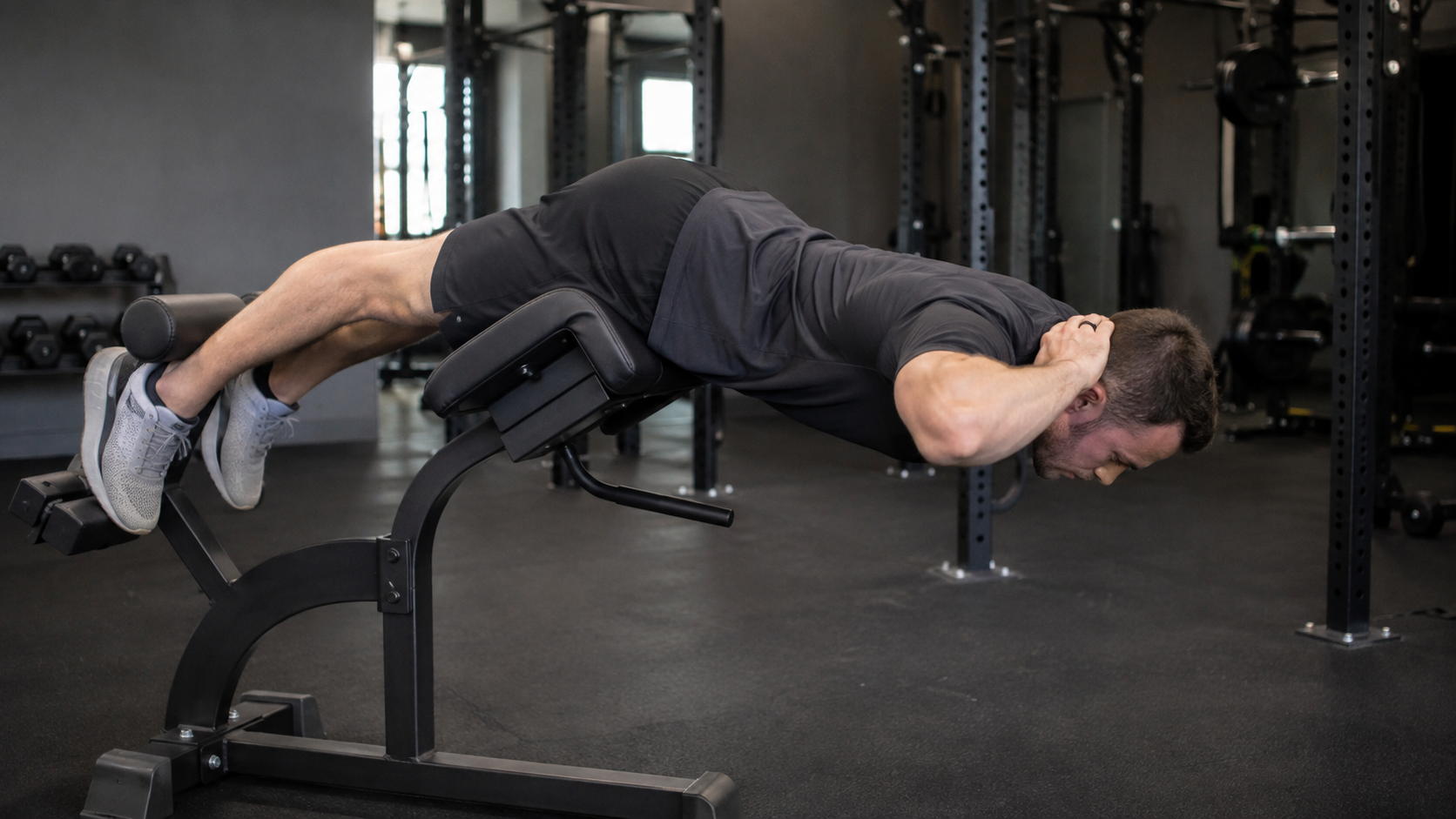
The rep usually fails in four ways: the pad and feet are not set cleanly, the torso drops too fast, the back loses its straight line, or the top position comes up short. On video, that shows up as a loose, rushed, or unfinished rep.
Corect can catch those faults from a phone video. It looks for whether the body stays controlled through the movement and whether the top actually comes back in line with the legs.
Mistake: the setup is off
If the bench is set wrong, the rep starts messy. Your upper thighs should rest on the pad and your feet need to be secured; if that does not feel locked in, the movement is harder to perform and harder to read.
A poor setup makes the rep look different every time. You lose a clear hinge and the back has to work around the shift instead of through the movement.
Mistake: the torso drops without control
The descent goes wrong when you drop into the bottom instead of lowering under control. On video, the torso falls fast, the back starts to round, or the rep turns into a swing that disappears below the frame before you can read it. What usually causes it is a loose setup that lets the torso collapse under bodyweight.
You can feel this as a sudden loss of tension through the back and hamstrings. You do not get a clean bottom pause, and the next rep starts from a dead stop.
Mistake: the back does not stay straight
You see the back lose its shape as the rep drops. Instead of one straight line, the torso changes angle early or the finish comes up short.
That means the position is slipping before the range is done. On this movement, the back needs to stay straight on the way down and come back up in line with the legs.
Mistake: the bottom is rushed or skipped
If you skip the bottom, the rep turns into a bounce. You drop quickly, never settle, then start back up before the torso has paused at the deepest point. On video, the descent looks rushed and the bottom never goes quiet.
A sloppy bottom is one where the torso never really stops before coming back up. Fix it by lowering under control, pausing for a moment, then rising only after the body is still.
Mistake: the finish cuts short
The rep is short when you come up near the top but stop before your torso is fully in line with your legs. On video, it looks like you got close and then quit early instead of finishing the range cleanly.
That is not the same as a sloppy setup or a bad line on the way down. This mistake shows up at the top: the last part of the rep never closes, so the finish never looks complete.
Fix it by pausing at the bottom, then raising until your torso is in line with your legs. The last frame should look finished, not just close.
What Corect can see in your video
Corect can score what the video shows on each rep: whether the torso stays controlled, the back stays straight, and the top position reaches line with the legs. That gives you feedback on the part of the movement the camera can actually catch, not another version of the checklist.
If the rep folds or rounds before the bottom, that shows up frame by frame. If it stops short at the top, Corect can see the finish is not complete.
How to clean up the rep
Clean this rep up by making the setup stable before you chase range. If your upper thighs are not planted on the pad or your feet are not fixed, the rep loses shape fast.
From there, keep the descent controlled and the spine steady. On video, the clean rep is the one that stays smooth from start to finish, not the one that has to be rescued halfway through.
Back Extension: the movement, step by step
- Adjust the hyperextension bench so that your upper thighs are resting on the pad and your feet are secured.
- Cross your arms over your chest or place your hands behind your head.
- Lower your upper body towards the ground while keeping your back straight.
- Pause for a moment at the bottom, then raise your upper body back up until it is in line with your legs.
- Repeat for the desired number of repetitions.
Common questions
What are the main back extension mistakes?
The page says the rep usually fails in four ways: the setup is off, the torso drops too fast, the back loses its straight line, or the top position comes up short.
What does a rushed back extension look like on video?
On video, the torso falls fast, the back may start to round, or the rep turns into a swing that disappears below the frame before it can be read.
How should the top of a back extension look?
The rep should come back up until the torso is in line with the legs. If it stops before that, the finish is short and does not look complete.
What can Corect see in a back extension video?
Corect can score whether the torso stays controlled, the back stays straight, and the top position reaches line with the legs.
The hardest part of fixing any of this is that you cannot see yourself mid-rep. Corect reads your form from a phone video and shows you what actually happened on each rep of your back extension — depth, bar path, where the breakdown starts. Try it free.