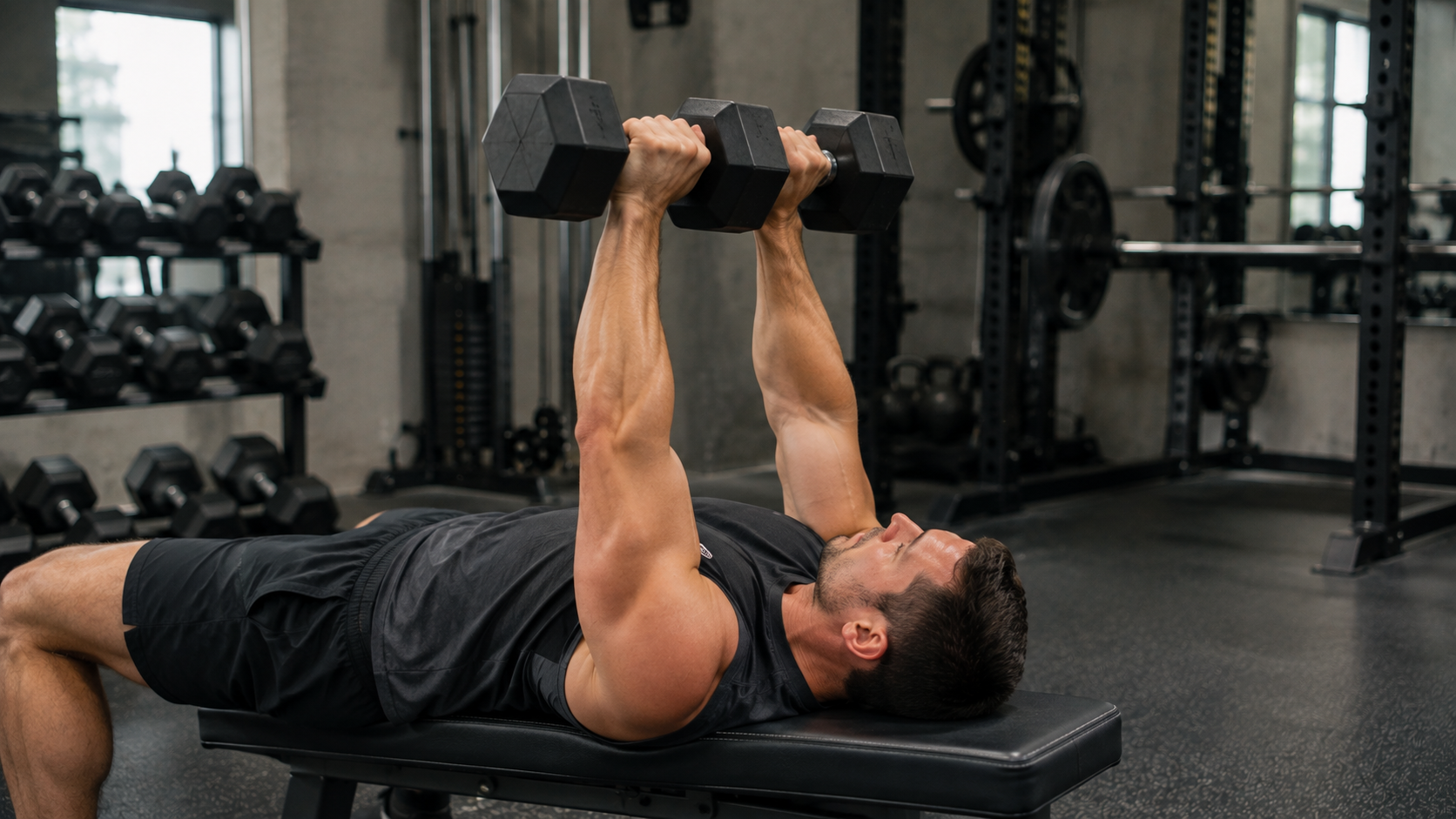
Set the dumbbells at shoulder width, palms facing away, then lower them to about chest level and press them back up by driving through the triceps.
It’s a dumbbell press variation for the upper arms, with the chest and shoulders helping.
How to set up on the bench
Set the dumbbells on your thighs and bring them into position one at a time. The goal is a clean start, not a swing or a heave.
Once they are at shoulder width, rotate your wrists forward and let the palms face away from you. They should feel balanced and settled there before you lower them.
How the hand and wrist position works
Your hands come to shoulder width, then the wrists rotate forward so the palms face away from you. That rotation is the true start position.
From there, the dumbbells should sit steady in front of you, not tilt back or drift loose. If the wrists stay turned back, the setup never really locks in before the first rep.
How to lower the dumbbells
Lower the dumbbells slowly to chest level, keeping the descent controlled and the path clean. You should see the weight move down without a drop, bounce, or shift into the shoulders.
The lowering phase should stay smooth enough that the triceps keep working all the way in. If the motion gets jerky or the dumbbells sink past chest level, the rep stops looking controlled.
How to press back up
A solid rep feels clean at the top: the elbows finish the work, the dumbbells come back together on the same line, and nothing turns into a shoulder grind.
If the weights start to drift or one side jumps ahead, the press is no longer staying tight.
Common form errors
The common errors show up after the setup is already in place: the dumbbells drift off shoulder width, the descent loses control, or the press stops moving straight back to the start. On video, you want to see the same path and the same position on every rep. If the dumbbells wander, flare, or finish unevenly, the rep has turned into a different movement.
How to tell if your reps are drifting off pattern
The rep starts drifting when the dumbbells stop looking controlled from one rep to the next. On video, watch for the path getting uneven or the dumbbells no longer returning to the same start.
If the descent gets sloppy, the shoulders are taking over. If the finish looks like a shove instead of a clean lockout, the rep has changed shape.
Good reps look the same from start to finish. If that pattern breaks, cut the set there and reset before the next rep gets uglier.
Quick answers to common questions
Should the dumbbells stay wide? Yes. Keep them at about shoulder width, with the wrists turned forward, and lower them smoothly until they reach about chest level.
What should the rep feel like? Steady on the way down and direct on the way up, with the upper arms staying organized and the triceps finishing the press.
What usually shows a problem? Uneven dumbbells, wrists that lose position, a rushed descent, or a rep that starts turning into a shoulder grind.
Dumbbell Close-grip Press: the movement, step by step
- Sit on a flat bench with a dumbbell in each hand, resting on your thighs.
- Using your thighs to help raise the dumbbells, lift the dumbbells one at a time so that you can hold them in front of you at shoulder width.
- Once at shoulder width, rotate your wrists forward so that the palms of your hands are facing away from you. This will be your starting position.
- As you breathe in, slowly lower the dumbbells to your side until they are about level with your chest.
- As you exhale, use your triceps to lift the dumbbells back to the starting position.
- Repeat for the desired number of repetitions.
Common questions
Should the dumbbells stay wide?
Yes. Keep them at about shoulder width, with the wrists turned forward, and lower them smoothly until they reach about chest level.
What should the rep feel like?
It should feel steady on the way down and direct on the way up, with the upper arms staying organized and the triceps finishing the press.
What usually shows a problem?
Uneven dumbbells, wrists that lose position, a rushed descent, or a rep that starts turning into a shoulder grind.
Corect analyses your lifting form from a phone video and shows you what changed rep to rep. See how it works.