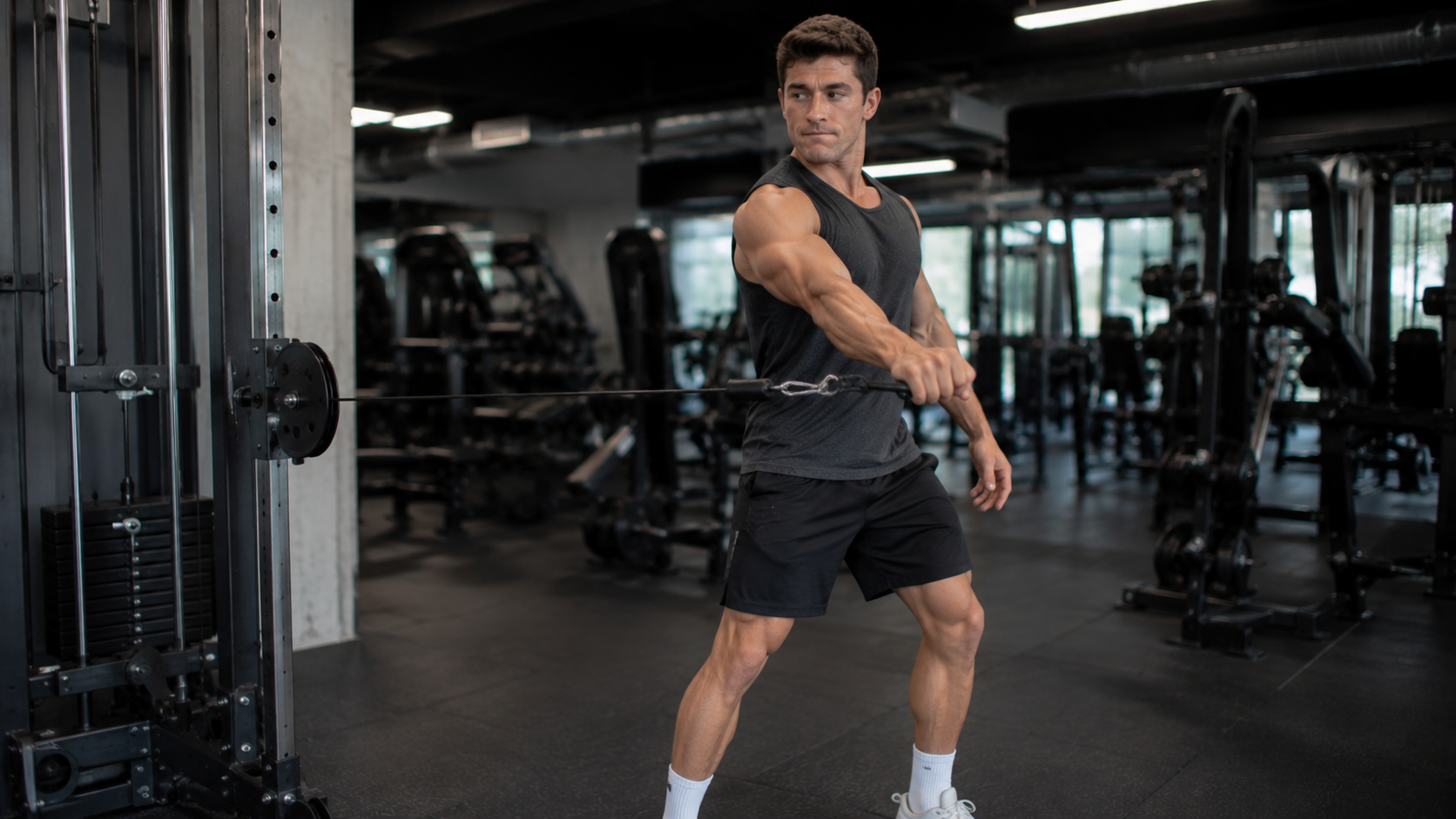
The cable twisting pull works your lats, shoulders, and biceps, and it places the movement on the back with shared arm and shoulder demand.
Because it is done one side at a time, the load moves through the lats as you pull and twist, while the shoulders and biceps help finish the rep.
Why the twist changes the load
The twist changes the pull from a straight row into a rotation under cable tension. That shifts the demand onto the back as the handle comes in and the torso turns, so the work does not stay in a fixed line. Keep the return slow so the cable keeps the load on the same pattern instead of dropping it.
What you should feel on a good rep
You should feel the lats do most of the work, with the shoulders and biceps assisting as you pull and rotate. The effort should build cleanly through the twist and finish with a strong squeeze in the back, not a loose, jerky pull.
When the arms take over
If your elbow folds early, the handle starts coming in off the arm instead of staying on a long cable line. If the turn happens before the pull builds, the rep turns into a twist-and-yank and the back stops setting the pace.
How setup changes muscle emphasis
Start facing the machine with the handle on a low pulley. Step away until your arm is fully extended, set your feet shoulder-width apart, and keep your knees slightly bent. A straight back and an engaged core keep the pull clean from the start, and you switch sides after your reps are done.
What the return should look like
On the way back, let the cable pull the arm forward under control so the lats, shoulders, and biceps stay working through the descent. Do not let the tension collapse, or the return stops loading the muscles that drive the rep.
How to tell if your form is off from video
Corect can analyze this movement from a phone video and score your form, so the same rep can be checked for clean setup, controlled pull, and a steady return on both sides.
Which muscle questions this variation answers
Lats do the main work, with shoulders and biceps helping through the pull. The twist changes where the rep feels strongest, so the movement stays back-led instead of turning into a straight arm pull.
Cable Twisting Pull: the movement, step by step
- Attach a cable handle to a low pulley and stand facing the machine.
- Grasp the handle with your left hand and step away from the machine, extending your arm fully.
- Position your feet shoulder-width apart, with your knees slightly bent.
- Keep your back straight and your core engaged throughout the exercise.
- Pull the handle towards your body, rotating your torso to the right as you do so.
- Squeeze your back muscles at the end of the movement.
- Slowly return to the starting position, keeping tension on the cable.
- Repeat for the desired number of repetitions, then switch sides and perform with your right hand.
Common questions
What muscles does the cable twisting pull work most?
The cable twisting pull works your lats, shoulders, and biceps. The lats do most of the work, with the shoulders and biceps helping as you pull and rotate.
Why does the twist change the load?
The twist changes the pull from a straight row into a rotation under cable tension. That shifts the demand onto the back as the handle comes in and the torso turns.
What should a good rep feel like?
You should feel the lats do most of the work, with the shoulders and biceps assisting. The effort should build cleanly through the twist and finish with a strong squeeze in the back.
How should the return look?
Let the cable pull the arm forward under control so the lats, shoulders, and biceps stay working through the descent. Do not let the tension collapse.
The hardest part of fixing any of this is that you cannot see yourself mid-rep. Corect reads your form from a phone video and shows you what actually happened on each rep of your cable twisting pull — depth, bar path, where the breakdown starts. Try it free.