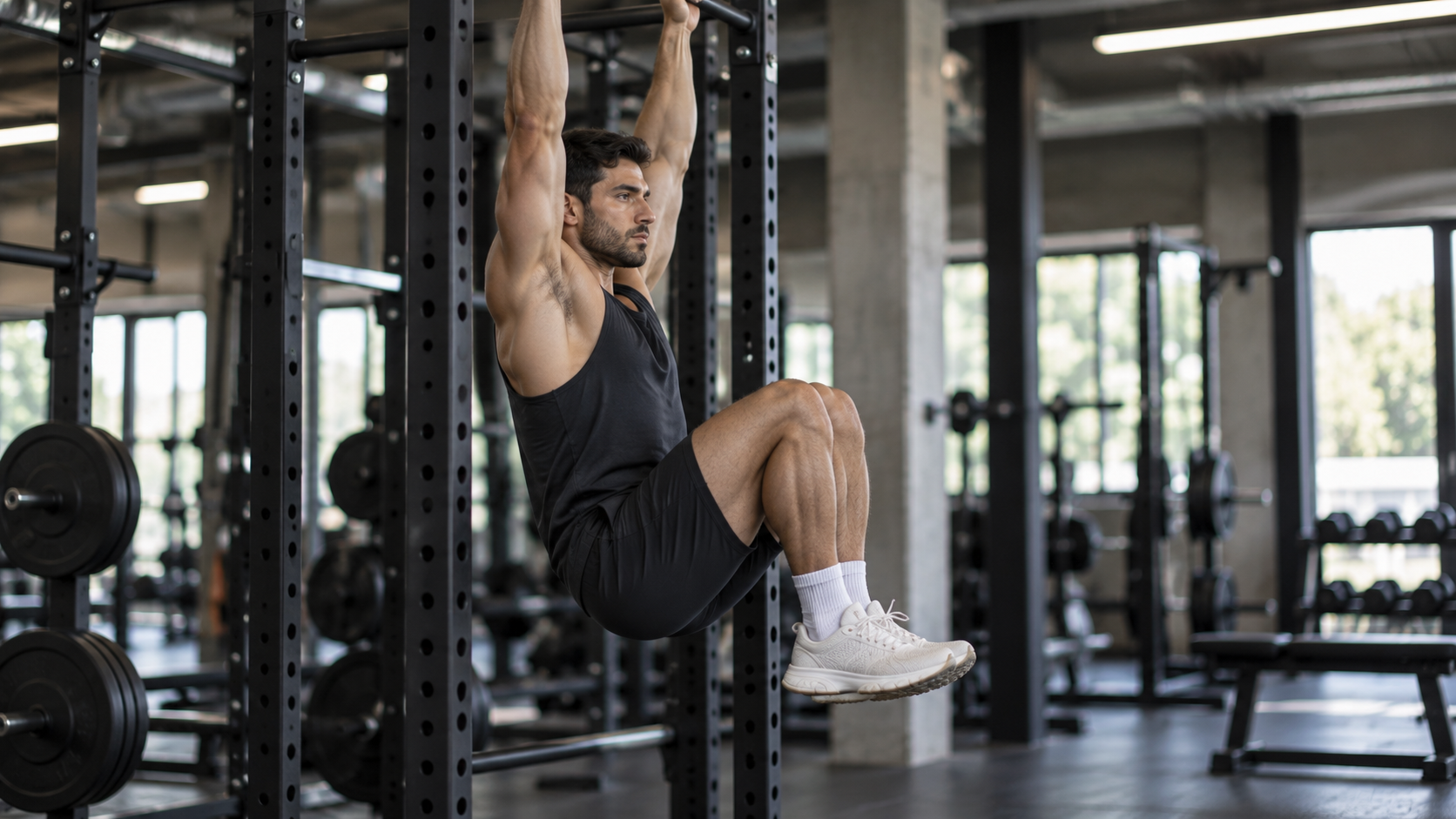
Use this to train your abs and hip flexors by lifting your knees from a true dead hang instead of kicking them forward. Your arms should start fully extended on the pull-up bar, with your palms facing away, before your knees move.
The first thing to check on video is the start position. If your elbows are already bent, the rep is not starting from a dead hang; you are pulling yourself into position before the abs and hip flexors do their work. At the top, your knees should rise under control toward your chest, not arrive there because your ribs flare and your hips swing.
The lower is where sloppy reps show up. If your legs drop fast and your body rocks forward, the next rep starts with momentum instead of control. Lower slowly until you are back in the same still hang you started from.
Setup on the bar
Hang with your palms facing away and let your elbows open completely before the first rep. On video, the start should look like a dead hang: straight arms, knees below your hips, and no forward drift through the ribs.
You are not trying to pull yourself higher on the bar. If your elbows stay bent, your shoulders are already helping and the knee raise starts from a shortened position. Reset until your arms look long and your body is still.
Before you lift, brace your waist enough that your ribs do not flare forward. The right start feels quiet: hands fixed on the bar, arms long, hips underneath you. The wrong start looks like a small swing before the knees move.
The rep path
Keep the rep strict enough that your knees rise because your hips fold, not because your body swings behind the bar. If your arms bend or your ribs flare before the first lift, the camera will show your hang shortening before the abs have done much work.
Brace through the waist and bring your knees up under control. A good rep looks like the knees travelling toward your chest while the bar stays above quiet shoulders; a bad one looks like the hips kicking forward and the torso leaning back to launch the knees.
At the top, pause long enough to squeeze your abs without curling into a loose swing. Then lower slowly until your arms are fully long again and your legs settle under you. If the knees drop fast and your body rocks into the next rep, the descent is feeding the swing instead of resetting the rep.
What good tension feels like
A clean rep feels like your waist stays loaded while your knees travel up under you. Your arms stay long on the bar, your ribs stay down, and the lift comes from bending at the hips instead of kicking your body forward.
At the top, the hard work should sit across your abs and the front of your hips. If your ribs flare, your hips swing, or your elbows bend before the knees rise, the rep is turning into momentum instead of a controlled knee raise.
On the way down, the same tension should still be there. Your knees lower slowly until you return to a full dead hang; if your legs drop and pull your body into the next rep, you lost control before the rep was finished.
Common mistakes
The main misses are bending the arms out of the hang and letting the hips swing before the knees climb. At the start of each rep, your elbows should stay long under the bar; if they bend first, you are pulling your body up instead of raising your knees from the waist.
Watch your ribs and hips from the side. If your ribs flare and your hips drift behind the bar, the next knee raise will usually turn into a forward swing instead of a controlled lift toward the chest.
Short range shows up as the knees stopping low while the trunk stays loose. You should see the knees travel up under control, then pause briefly at the top instead of bouncing away as soon as they rise.
The lower matters because it decides the next rep. If your legs drop fast, they pull your body into a swing; lower slowly until you are back in a full hang before starting again.
How to make the rep easier or harder
Make it easier by cutting the knee raise short before your ribs flare or your hips swing forward. Start each rep from straight arms, then lift only as high as you can without bending your elbows or kicking your knees up.
Make it harder by making every part of the path visible and controlled. Your knees should travel up without your body drifting behind the bar, pause near the top, then lower until you are back in a still dead hang before the next rep. If the lower turns into a drop or the next rep starts from a swing, the set is too loose.
How to check your form on video
On video, the rep should start from a true dead hang: arms fully extended, palms facing away, body still under the bar. If the first frame already shows bent elbows, flared ribs, or your hips drifting forward and back, you are starting the knee raise from tension and swing instead of a clean hang.
Watch the knee path next. Your knees should travel up toward your chest because your hips and knees bend, not because your lower body kicks forward. From the side, the rep should look compact: knees rising under control, ribs staying quiet, hips not chasing the knees into a swing.
At the top, the pause should be visible. If the knees bounce and immediately fall, you did not own the top position. On the way down, your legs should return slowly until your arms are fully extended again and your body is still enough to start the next rep without using momentum.
Quick answers to related questions
If you want this movement to count, the rep has to start from a real dead hang: arms long, palms over the bar, legs still before the knees move. If your elbows are already bent or your ribs are flared before the lift, the first thing the camera will catch is you pulling yourself into position instead of raising the knees.
As the knees travel up, they should come from the hips folding and the abs holding the ribs down. If your hips swing forward, your knees may still rise, but the rep has turned into momentum.
Use assistance only if it lets you keep the same rep shape: full hang, controlled knee path, clear pause, slow lower. If the lower drops fast and your body swings into the next rep, you are not ready to remove assistance or add more reps.
Assisted Hanging Knee Raise: the movement, step by step
- Hang from a pull-up bar with your arms fully extended and your palms facing away from you.
- Engage your core muscles and lift your knees towards your chest, bending at the hips and knees.
- Pause for a moment at the top of the movement, squeezing your abs.
- Slowly lower your legs back down to the starting position.
- Repeat for the desired number of repetitions.
Common questions
How should I start an assisted hanging knee raise?
Start from a true dead hang with your arms fully extended, palms facing away, and your body still. If the hang is already broken or swinging, reset before you lift.
What is the correct rep path?
Bring the knees up under control so the hips fold instead of the body throwing backward. The rep should stay stacked and finish with a brief top squeeze before a slow lower.
What are the most common mistakes?
The main misses are losing the full hang at the start and turning the rep into a swing. A fast drop on the way down also kills control and carries momentum into the next rep.
How can I tell if my form is good on video?
The rep should begin from a dead hang, with no bent elbows or sway in the first frames. The knees should travel in a compact path, with a brief pause at the top and a slow return to the start.
The hardest part of fixing any of this is that you cannot see yourself mid-rep. Corect reads your form from a phone video and shows you what actually happened on each rep of your assisted hanging knee raise — depth, bar path, where the breakdown starts. Try it free.