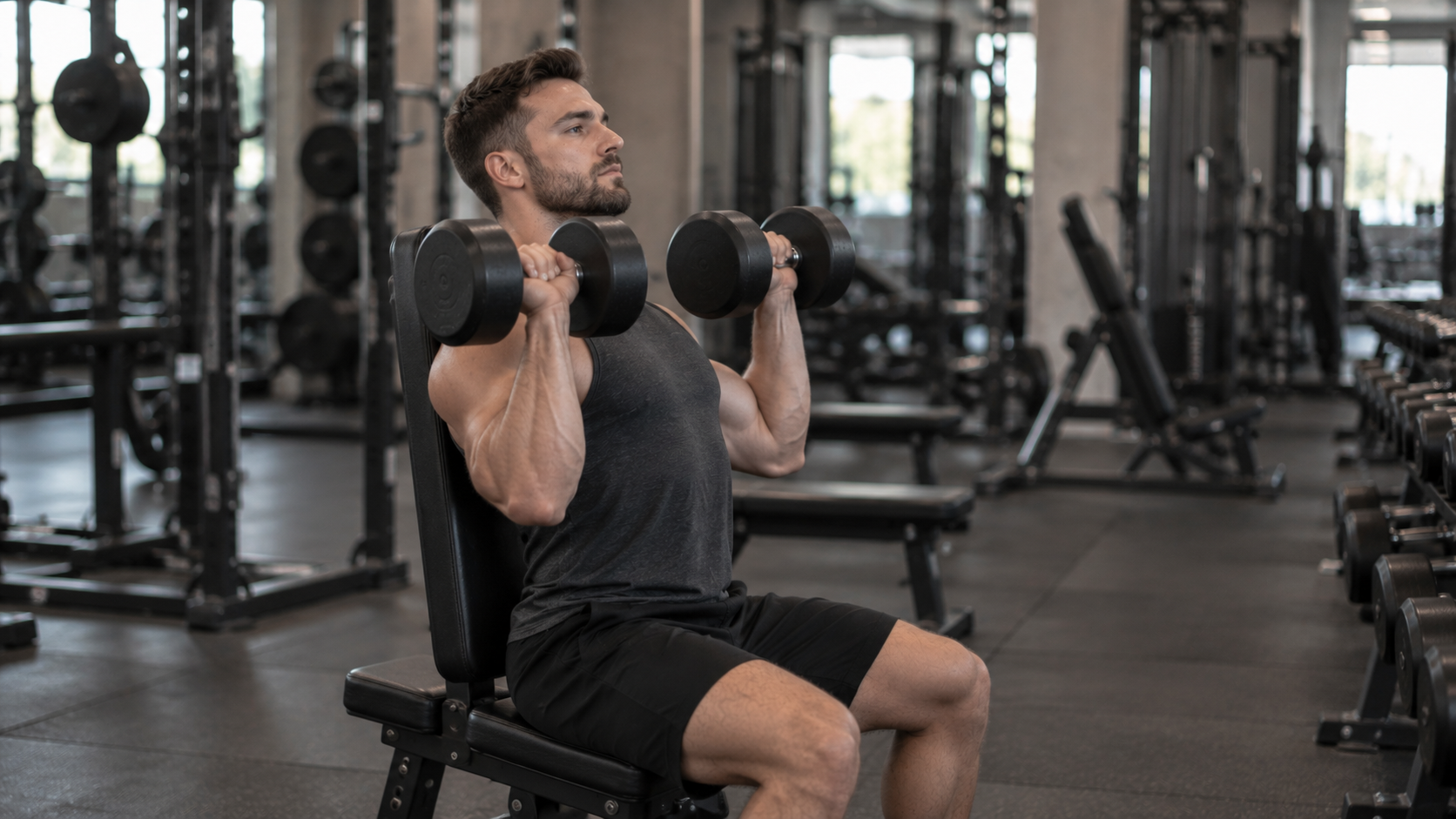
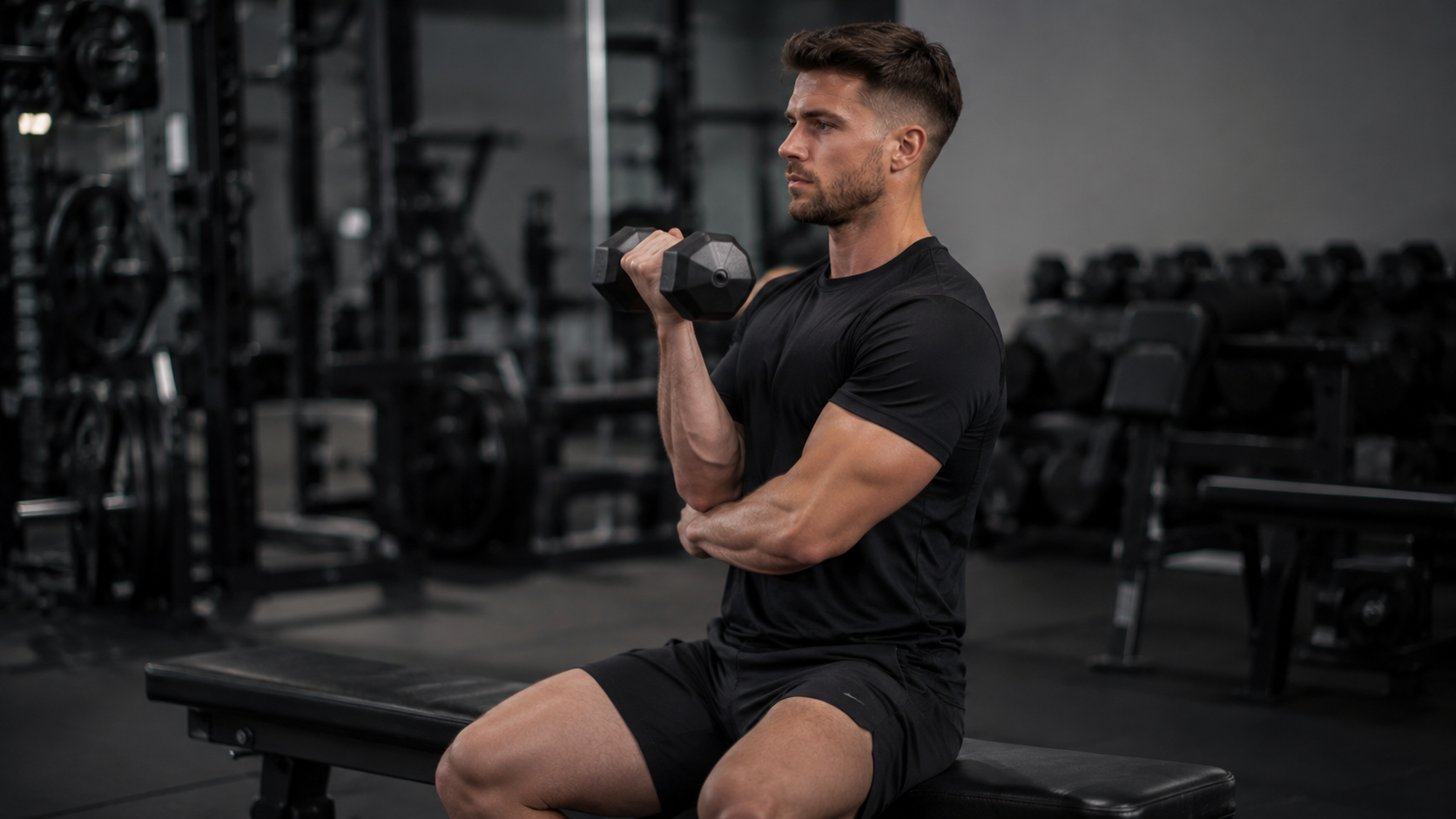
You should feel this most in your forearms, with the shoulders and biceps helping. The dumbbell turns in your lower arm while your upper arm stays quiet, so the work shows up there instead of in your torso.
Set up on the bench
Sit tall on the bench and start with the dumbbell resting on your thigh. That start keeps the rep honest: you should feel the weight settled and ready to move, not floating out in front of you.
Keep your back straight and your torso quiet. The elbow should stay close to your body, with the upper arm parked so the forearm does the work instead of the shoulder rolling forward to help.
From the setup, the path should feel clean and controlled before the dumbbell leaves your leg. If you have to shrug, lean back, or let the elbow drift away just to get moving, the setup is already off.
Think of the start as a reset point for each side. Get one arm set, do the reps with control, then switch and match the same posture on the other arm.
Drive the dumbbell to shoulder height
The dumbbell should leave the thigh cleanly and arrive at shoulder height without a jerk. Keep the upper arm quiet; the elbow should stay close instead of drifting out or turning the rep into a curl.
Rotate the forearm, not the whole arm
Rotate just the forearm while the upper arm stays fixed. From shoulder height, turn the hand outward, then reverse the same way without adding extra movement.
Pause and return under control
At the top, the rep should look still, not rushed. You finish the forearm turn, hold that shape for a beat, and the dumbbell should feel settled instead of drifting or wobbling.
The return is where the movement stays clean or falls apart. Let the forearm unwind slowly back to start while the upper arm stays quiet and the elbow keeps its place near your side. If the shoulder starts rolling forward, if the wrist twists early, or if the dumbbell drops back in a quick snap, the rep is no longer controlled. The right tempo feels smooth all the way down, with the lower arm doing the work and the shoulder just holding position.
Switch sides only after you finish the full set on one arm, then repeat with the same control on the other.
Common errors in video
If the elbow starts drifting away from your torso, the rep stops looking like a clean forearm rotation and starts looking like the shoulder is helping. You should see the upper arm stay quiet while the dumbbell moves in a smooth arc; if the shoulder rolls forward, the hand may still turn, but the motion gets bigger and less controlled.
Rushing the return shows up fast in video. The dumbbell drops back to the start instead of coming down under control, and the forearm loses the smooth, even turn you want. That usually comes with a little torso twist or a lean to one side, especially when the second side is weaker.
A clean rep looks still through the upper arm and torso, with the wrist and hand doing the work. If the body has to swing to finish the rep, the lower arm is no longer the main mover.
How this differs from row variations
Keep the upper arm quiet and let the forearm do the rotation. The tell in video is the elbow: it stays close to your body while the dumbbell rises from thigh to shoulder height.
At the top, you want a brief pause, then a slow return with the forearm rotating back under control. Stay seated and upright, finish one side cleanly, then switch arms.
Quick checklist for clean reps
Use the same path on both halves of the rep. If the shoulder has to help, the elbow leaves your side, or the dumbbell stops moving in one clean arc, the rep is off.
The setup should stay quiet, the turn should stay in the forearm, and the pause at the top should look controlled. Then lower it back the same way and switch arms without changing the pattern.
Dumbbell Seated One Arm Rotate: the movement, step by step
- Sit on a bench with your back straight and hold a dumbbell in one hand, resting it on your thigh.
- Raise the dumbbell up to shoulder height, keeping your elbow close to your body.
- Rotate your forearm outward, away from your body, while keeping your upper arm stationary.
- Pause for a moment at the top, then slowly rotate your forearm back to the starting position.
- Repeat for the desired number of repetitions, then switch to the other arm.
Common questions
How should I set up for the dumbbell seated one arm rotate?
Sit tall on the bench with the dumbbell resting on your thigh. Keep your back straight, your torso quiet, and your elbow close to your body so the forearm does the work.
What should move during the rep?
Rotate just the forearm while the upper arm stays fixed. The dumbbell should rise cleanly to shoulder height, then reverse under control without extra movement.
What are the most common errors?
Letting the elbow drift away, shrugging, leaning back, rushing the return, or twisting the torso are the main signs the rep is getting sloppy.
How should the top and return look?
At the top, the rep should look still and controlled with a brief pause. On the way down, lower it slowly while keeping the upper arm quiet and the elbow near your side.
Corect analyses your lifting form from a phone video and shows you what changed rep to rep. See how it works.