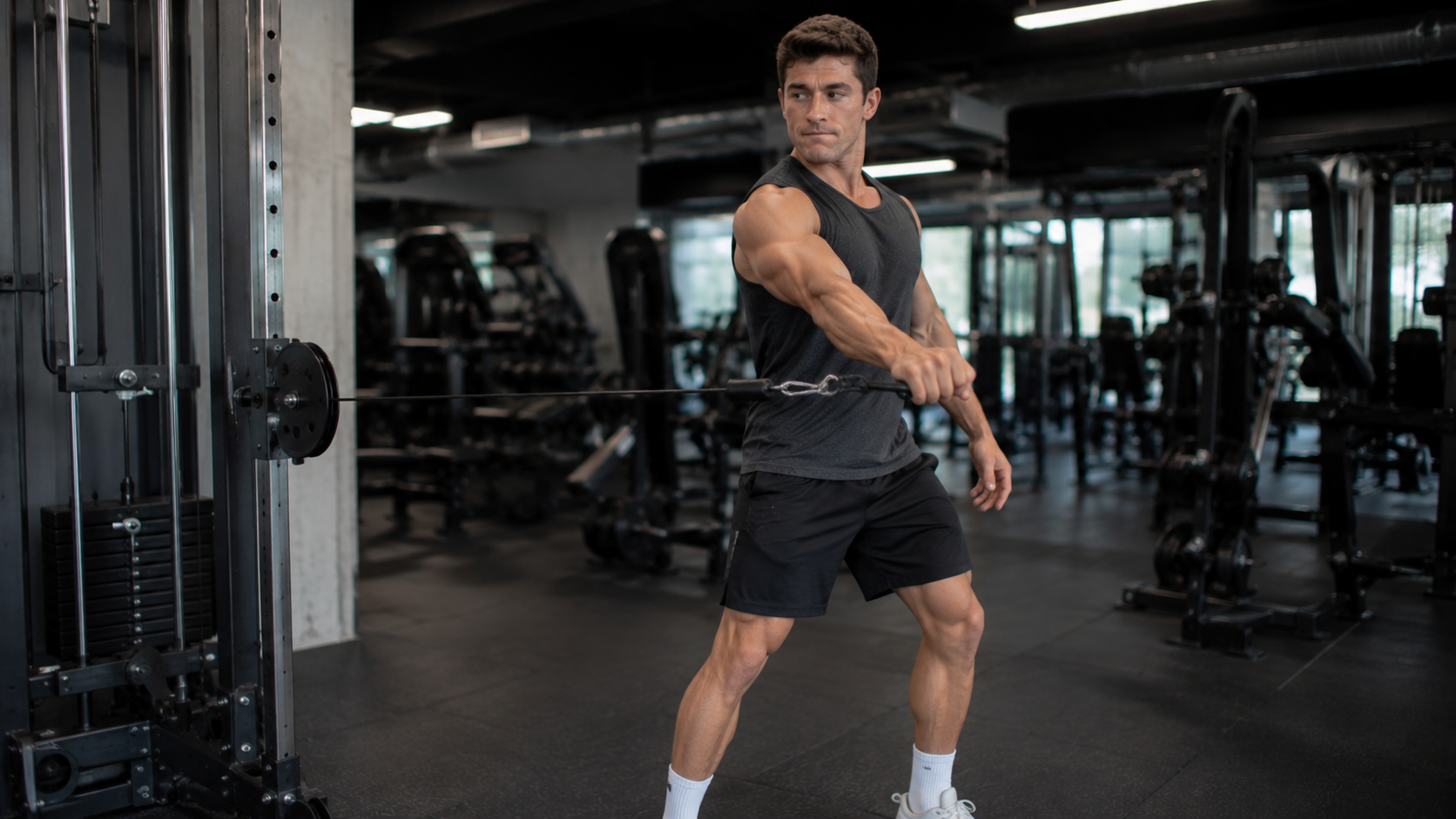

Stand with your feet shoulder-width apart, dumbbell in each hand and palms facing your thighs. Keep your arms straight, lift the dumbbells in front of you to shoulder level, pause, then lower them back to the start under control.
This is a shoulder exercise for the front deltoids, with the biceps and trapezius helping. It fits home or gym work, and Corect can score your rep from phone video.
How to set up
Set up so the dumbbells start dead still. You want your torso stacked and your shoulders quiet, so the first inch of the rep comes from the front delts, not from a lean or a swing.
Hold the dumbbells in front of your thighs with your arms straight. If your shoulders creep up or your chest drives the weight off the bottom, the lift stops being a clean front raise and turns into momentum.
How to perform the rep
Use the rep to keep the shoulders doing the work, not the body. The clean version is smooth, quiet, and controlled; if you need a swing, the load is too heavy.
Watch for a steady torso, a clean finish at shoulder level, and a slow return. If the movement turns into a shrug, a lean, or a drop on the way down, the front delts are not getting the full work.
What it should feel like
You should feel the front delts doing the lift while the dumbbells travel smoothly to shoulder height. Clean tension means the arms stay straight and the weight rises under control; cheating shows up when the torso sways, the shoulders shrug, or the elbows bend to help the rep.
At the top, the front of the shoulders should still be working, not the traps taking over. On the way down, the dumbbells should lower slowly back to the start with the shoulders staying loaded.
Common form errors
The main mistakes are swinging the dumbbells up, shrugging the shoulders, bending the arms, and taking the lift above shoulder level. Any of those turns a clean front raise into momentum and trap work, and the rep stops looking like shoulder flexion.
If your torso rocks back or your feet shift to help the weight leave the start, the front delts are no longer doing the work alone. In video, the dumbbell path will arc forward and up with a little body throw instead of rising under control from a quiet neutral standing posture. The rep should feel smooth; the wrong version feels like you have to heave the weight.
Shrugging is easy to spot because the shoulders creep toward the ears before the dumbbells reach shoulder height. That usually means the trapezius is taking over. Bent arms shift the load into the biceps and make the lift shorter and easier to cheat.
Stop at shoulder level. Higher than that usually adds more shrugging and less clean rep quality. The lowering should be slow and controlled, not a drop.
How Corect judges the movement
Corect can analyse this movement from a phone video and score its form. For this lift, it can use the visible rep shape to check for a clean shoulder raise instead of a body swing. The dumbbells should move in front of you, the arms should stay straight, and the top of the rep should finish at shoulder level with the torso still quiet.
A good rep looks controlled from the first inch up to the last inch down. If the shoulders stay down and the lift comes from the front delts, the motion looks steady and the dumbbells stop without drift. If the traps take over, you usually see the shoulders creep up toward the ears before the hands reach the top.
Corect can also watch the lowering phase. A controlled lowering means the dumbbells come back to the start at a steady tempo, not drop.
The biggest breakdowns on video are torso sway, bent arms, or a finish above shoulder level. Those all make the lift easier to fake and harder to judge.
Front raise questions people ask
It targets the front deltoids, with the trapezius and biceps helping. A side raise shifts the load out to the side; this one keeps it in front of the body.
If you want a simpler version, slow the lowering phase and keep the same path. A basic alternative is just a plate raise with the same strict arm path.
Front Raise: the movement, step by step
- Stand with your feet shoulder-width apart, holding a dumbbell in each hand with your palms facing your thighs.
- Keeping your arms straight, exhale and lift the dumbbells in front of you until they are at shoulder level.
- Pause for a moment at the top, then inhale and slowly lower the dumbbells back down to the starting position.
- Repeat for the desired number of repetitions.
Common questions
What muscles does the front raise work?
It targets the front deltoids, with the biceps and trapezius helping.
How high should I raise the dumbbells?
Stop at shoulder level. Going higher usually adds more shrugging and less clean rep quality.
What are the most common front raise mistakes?
The main mistakes are swinging the dumbbells, shrugging the shoulders, bending the arms, and lifting above shoulder level.
How does Corect judge the movement?
Corect can analyse the lift from phone video and score whether the rep is a clean shoulder raise instead of a body swing. It checks for straight arms, a quiet torso, and a finish at shoulder level.
The hardest part of fixing any of this is that you cannot see yourself mid-rep. Corect reads your form from a phone video and shows you what actually happened on each rep of your front raise — depth, bar path, where the breakdown starts. Try it free.